Dispatch 004: Artificial Intelligence Operational Usage
Date: May-Present
Location: Washington, D.C.
Associated with: The Gigawatt Project
Type: Field Transcript
Status: Published
Conversations from the Ground: Dr. Thomas Danielson
Savannah River National Lab | Special Competitive Studies Project AI Expo | Washington D.C. May 2026
Recorded: 05/07/2026 10:56 AM
PT 2
In May, I had the honor to sit down with Savannah River National Lab scientist Tom Danielson. Finding myself in Washington, D.C. for the Special Competitive Studies Project AI Expo, I sought to learn how Artificial Intelligence was being implemented on the national level. With the talk of AI in the mainstream regarding consumer facing AI and LLMs being the majority of conversation, I was inclined to discover more about what was happening at the larger scale.
In dispatch 004 and the second of The Gigawatt Project, I present here a partial transcript from my radio broadcast and recorded interview from the floor and will release the full conversation over a series of dispatches.
Source: Personal recorded interview with Tom in May 2026. Which was edited for special on-air broadcast use for Uncontaminated Sound WGXC 90.7 FM June 2026. Machine transcript (Adobe Premiere Pro) and Otter.ai, lightly cleaned of filler; content unedited. Additionally, a review of the original audio has been conducted. The broadcast version is linked at the bottom of this page.
Tom Danielson: So if you have documents that a have a lot of handwriting in them, right. There may be a model out there that's readily accessible so that we can come in and leverage that really quickly. We don't have to reinvent the wheel. It's going to prevent a lot of this duplication of effort that can sometimes happen.
Rob Lundberg: Well, question on that note too. How do you, I guess fact check the AI because with all this data and, you know, prior to really the rapid implementation of AI, human systems were in place to just, you know, really, check the nitty gritty of the database and the data. Do you have human systems in place as well just to fact check the data sets and analysis?
Tom: Yeah, absolutely. So I think, this is a big area of emphasis for us. Is kind of the evaluation of AI systems. And I think it definitely not to dodge. I don't want this to be a dodgy answer, but it depends on what your end use case is, right? In terms of what the level of rigor has to be.
Tom: So when we think about, some of the Em (environmental management) work that we have going on or what, working in facilities. Right. Especially with, with radioactive waste and those types of things.You want a very high level of certainty and a lot of checks that's going be in place, in order for those to to to operate correctly, right?
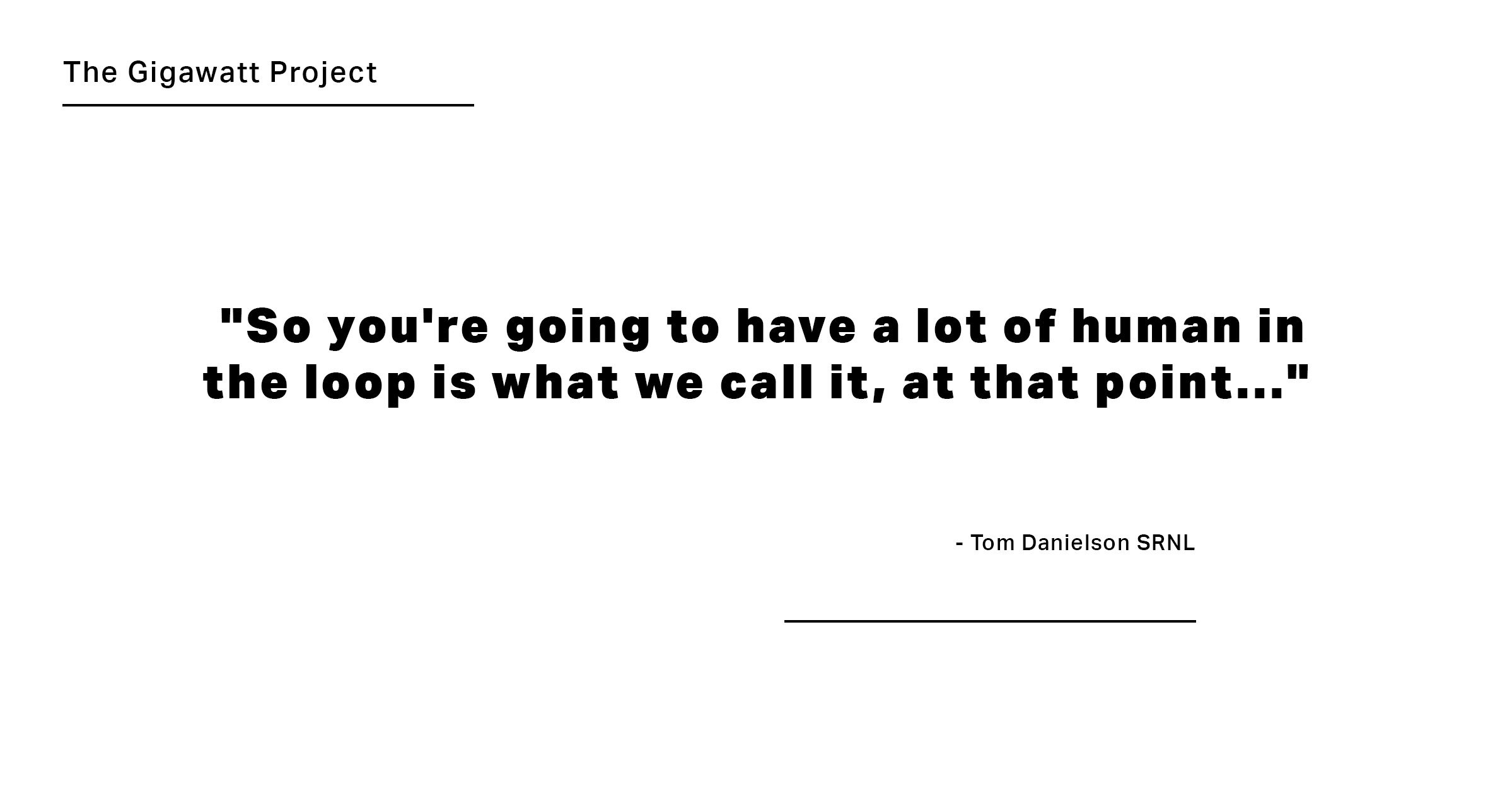
So you're going to have a lot of human in the loop is what we call it, at that point, when it comes down, if you're using it for report generation, those types of things, right? You want to get your information correct, but maybe you can rely on some of the more standardized, evaluation approaches.
Developing sort of these evaluation test sets, ensuring that the model performs at some, expected performance across time. And then you kind of know the level to which you need a human in the loop involved. But at the same rate, there's not a safety consequence necessarily. If, if you have, you know, an erroneous language in, you know, in your report.
Rob: There's always a fallback with, checks and balances, but, the I use it in systems with human, experts as well.Tom: Exactly
Rob: Yeah of course, just let the machines take over. Not take over. Sorry, not to be like, you know, sci-fi guy, but I understand, you know, there has to be... a system in place for those safety controls as well.
How big of an issue is the ground water issue and the nuclear aspects in your what you're you're tackling, what challenges have you faced in your position in this matter, in the nuclear cleanup, in site facilities and decommissioning?
Tom: Yeah. So, of course, there are a number of challenges from any industrial type operation, right where you're working with chemicals and these types of things.So there, there are challenges. The Department of Energy has made a lot of progress in terms of their cleanup mission. So, we're dealing, in many cases, with a lot of very stable, quote, unquote, cleaned up groundwater plumes that are that are present, so there's a lot of technical rigor that goes into those activities where we see opportunities for AI is in the monitoring aspects of that, those groundwater plumes.
So in many cases, like I've said, many of them are cleaned up, stable plumes, we know how they're evolving or changing and and potentially what could cause any shift, right?
And so this is why the monitoring programs that the Department of Energy have are set up the way that they are, and why they put performance objectives in place to ensure that those are met. And you know, there's some safety for human health in the environment, but once those are stabilized plumes that monitoring goes on for decades out into the future, right?
Contaminants continue to live on in many cases. I mean, in radioactive waste, you have some decay and things that occur, but, but the plume can, can remain for quite a long time.
So, so some of the AI approaches that we're taking are monitoring sort of the proxy variables to be able to allow us to predict what the concentration would be. And then again, in terms of the checks that you would do, you would still send a human out to sort of have a calibration check, or something like this, right manual sample and analysis to ensure that your forecast or your projection was was actually correct.
Maybe you can decrease the frequency at which you actually do that. So again, there are challenges, but some of those challenges are that there's a lot of time and effort that's put into the sampling aspects that I think...
So again, there are challenges, but some of those challenges are that there's a lot of time and effort that's put into the sampling aspects that I think could potentially be reduced, especially in these cases where the mess is cleaned up, so to speak, right?
Rob: ...thank you for that.